Categories
Uncategorized

Binance Reveals the Secret Behind Its Cryptocurrency Futures Success

Aaron Gong, vice president of futures at major cryptocurrency exchange Binance, explained to the press how the firm managed to become one of the top crypto futures trading platforms.

As reported earlier this week, Binance recently overtook BitMEX and became the second-largest platform in terms of 24-hour Bitcoin (BTC) futures trading volume. When asked whether he is surprised by such success, Gong said that the firm created the product with the plan of becoming the top Bitcoin futures trading platform:

“We knew we would be there soon, and we made it in slightly more than 6 months’ time.”

The reasons for Binance’s futures success

According to Gong, the three primary reasons behind the success of Binance’s futures products are the low taker fees, new features and a large amount of altcoin pairs. He said that too many exchanges offer negative maker fees:

“Too many other exchanges offer negative maker fees, where most orders are just computerized market makers competing for best bid and ask with extremely limited taker interest during periods of low-volatility.”

Gong also said that innovation also drives trading volumes when it comes to Binance’s futures. He claimed that the exchange has had a few firsts when it comes to the crypto futures market:

“We are the first major crypto exchange to launch max 125X leverage for BTC contracts, and the first of its kind to launch cross collateral and smart liquidation mechanism. These features have gained tremendous popularity amongst our users.”

The third reason for the success of Binance’s futures contracts, Gong explained, is the number of altcoin contracts. He said that the firm launched 24 futures contracts on the platform, adding:

“As of today, Binance Futures houses half of the top 10 most liquid altcoin contracts, many of which are also the most traded pairs amongst all futures exchanges.”

Binance’s key to future success

Gong’s strategy to drive the volume of futures contracts on Binance is to continue bringing more functionalities and products to the industry. He said that he believes Binance has outdone its competitors, as other crypto trading platforms suffered problems such as overloads, poor risk management, and counterintuitive product designs. He explained that Binance’s design was largely driven by user’s complaints about other platforms:

“We specifically aimed to address these issues and improve the users’ experience. As such, we put tremendous efforts to build an industry-leading matching engine that is able to process more than 100,000 orders per second. […] Whilst there were issues of system overloads, outages, glitches, and even rollbacks elsewhere, we’ve proven time and again to be a safe, reliable, cheap and liquid venue for hedging.”

It is worth noting that Binance’s trading platform ran into a number of issues in February. On Feb. 19, the exchange halted trading to resolve an unexpected technical issue with its infrastructure.

As a Feb. 25 Cointelegraph analysis illustrated, this incident took place after a week in which the platform was often unresponsive to trader input as the exchange was unable to manage a large uptick in user volume.

In early March, Binance halted trading again to fix a malfunction. The exchange’s co-founder and CEO Changpeng Zhao purportedly blocked Jay Hao — the CEO of competing exchange OKEx — on Twitter, after he publicly offered to help fix the infrastructure.

However, Gong said that the malfunctions did not affect Binance’s futures trading infrastructure and that futures traders were not affected:

“Our futures system has been proving to be performing well during the most volatile period since we launched. The futures market is running on a separate matching engine.”


Categories
Uncategorized

Bitcoin Price Did Not Crash 60% Due to Coronavirus, Says Binance CEO

The coronavirus pandemic was just the spark that ignited the current global economic meltdown, not its cause, the CEO of Binance says.

In a blog post on March 20, Changpeng Zhao, known as “CZ” in cryptocurrency circles, argued that coronavirus had shown that the world’s economy is far too weak.

CZ: The economy “should be stronger”

Asked whether he felt conditions this year were different from the global financial crisis (GFC) of 2008, he summarized:

“In 2008, there wasn’t a pandemic pausing global economy. But I believe the Coronavirus is just a trigger, not the root cause. Our economy should be stronger, at least strong enough to survive some shocks.”

Zhao was speaking as Bitcoin was increasingly decouplingfrom the misery facing traditional markets. After a historic daily fall last week in line with stocks indexes, this week saw a startling recovery which at one point neared 90%.

Since then, BTC/USD has cooled, trading down around 7% in the past 24 hours. Unlike the legacy system, however, Bitcoin is not “broken,” says Zhao.

At some point, investors will stop hoarding cash — a practice that has strengthened the dollar during coronavirus — and instead begin broadening their portfolios again. Among the destinations for wealth will be Bitcoin.

“Have people bought more bitcoin yet? No, in most cases. Many of them are still panicking over toilet paper,” Zhao continued. 

“These changes take time to propagate in the economy. Changes don’t happen immediately when a mass population is involved.”

A “safe haven”?

The comments echo those of Andreas Antonopoulos, the cryptocurrency educator who predicted the impact of a financial crisis on Bitcoin with uncanny accuracy several months ago. As  reported, Antonopoulos said that Bitcoin would initially fall hard, as investors exited crashing stocks, but then recover. 

Also favoring that sequence of events was John Bollinger, the creator of the Bollinger Bands volatility indicator, who argued that investors “sell what they can” under such circumstances. The intensity of Bitcoin’s fall, however, caught him off-guard.

“Truly did not see that coming, I thought it might act as a safe haven asset,” he tweeted at the time.

For Zhao, however, it was clear that Bitcoin will function as a safe haven in the future, given that its supply is fixed and cannot be manipulated like fiat currency.

“Don’t expect bitcoin to be guaranteed to go up when the Dow Jones index crashes, or vice versa,” he said. 

“It’s not a perfect inverse correlation product. If you want that, you should just short the Dow Jones Index futures.”

Categories
Uncategorized

Woman Arrested for Stealing $480,000 From Crypto Exchange She Co-Founded

A woman was arrested in Bengaluru, India on March 17 for allegedly stealing 63.5 Bitcoins (BTC) from Bitcipher Labs — a cryptocurrency exchange that she had previously co-founded.

The thefts took place on January 11 and March 11 respectively, resulting in $480,000 worth of BTC being stolen from Bitcipher.

Bitcipher co-founder steals $480,000 in BTC
Ayushi Jain, the 26-year-old former-employee, was found to have stolen 63.5 BTC from hardware wallets owned by the exchange.

Indian police acted in response to a complaint filed by Bitcipher Labs’ CEO, Ashish Singhal, who had identified the two unauthorized transactions.

The Bengaluru Investigation Department stated that an “investigation revealed the complainant had hardware wallets in which Bitcoins were stored, and a 24-word passphrase (password) was written on a piece of paper.”

Police suspected that the thief was “someone proficient in using this technology, and who was closely associated with the firm”, due to the fact that the culprit was able to operate a cryptocurrency hardware wallet and access the funds using the wallet’s corresponding passphrase.

Stolen funds were recovered
After preparing a list of the exchange’s former employees, Ayushi was identified as a likely suspect, as she had quit the company on Dec. 16, 2019, despite having co-founded the firm alongside Singhal in 2017.

After being detained, Ayushi confessed to the theft. The stolen funds were recovered by police. A senior police officer stated:

“On Wednesday, we took Ayushi into custody and searched her house. We seized a laptop which contained the history, showing how Ayushi used the passphrase and stole money in installments between January and March. She confessed to the crime. By Thursday afternoon, we recovered the entire amount.”

Police seized Ayushi’s laptop, and all stolen funds have been returned to the exchange.

Crypto Exchanges Rush to Enter Indian Market
India has become a renewed focus of the cryptocurrency community. Recently, the Supreme Court reversed the Reserve Bank of India’s ban on financial institutions, and are now providing services to businesses operating with cryptocurrencies.

Despite several cryptocurrencies rushing to enter the Indian market, a recent parliamentary investigation has revealed that only two cryptocurrency exchanges are licensed with the country’s Ministry of Corporate Affairs.

Categories
Uncategorized

Bitcoin Price Analysis: Is This The Day Bitcoin Had Been Waiting For 11 Years?

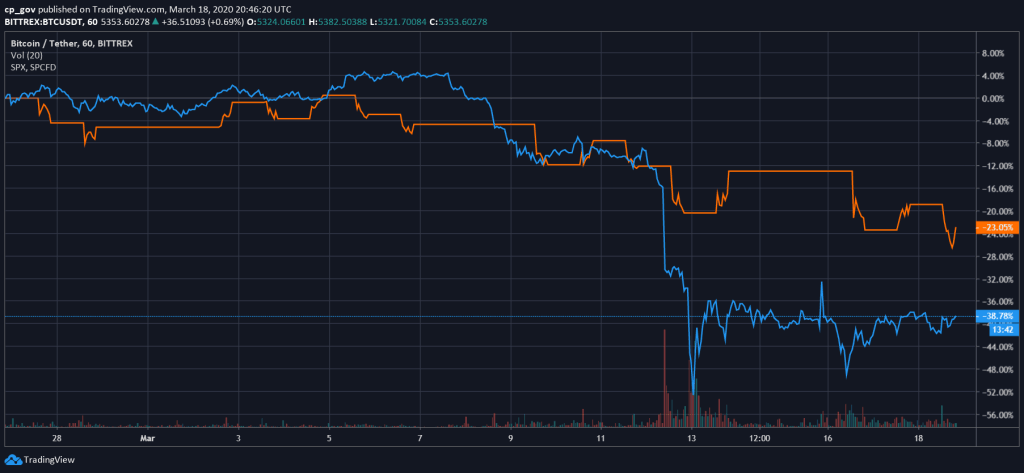
For the past few weeks, Bitcoin had been following the crashing global markets. While the S&P 500 and Nasdaq lost more than 30% over the past month, Bitcoin followed them but with a little bit of leverage.

The primary cryptocurrency is now trading at a 50% discount from the highs of mid-February, when it was trading above the $10,000 mark.

Many crypto enthusiasts waited for this moment. Bitcoin was born after the most recent significant financial crisis, the one of 2008. Nowadays, Bitcoin is facing its first real economic collapse, but so far behaving just like any other asset. Not the way Satoshi Nakamoto expected it to be.

Turning Point For BTC?

We could see the same positive correlation between Bitcoin and the stock markets over the past weeks. However, during the past days, Bitcoin holds firmly, trading inside a range between $5000 and $5500. This is despite another plunge of 5-6% in the major indexes.

Is this the turning point, when Bitcoin says goodbye to the positive correlation in order to become a real safe-haven asset? Only time will tell. Just a reminder, Gold crashed at the beginning of the 2008 financial crisis, just as it does now, before starting to be a hedge and started soaring.

BTC Vs. S&P500 over the past days. Correlation fading away?

Crypto Market Data
Total Market Cap: $150 billion

Bitcoin Market Cap: $95.6 billion

BTC Dominance Index: 63.7%

*Data by CoinGecko


Key Levels To Watch & Next Possible Targets
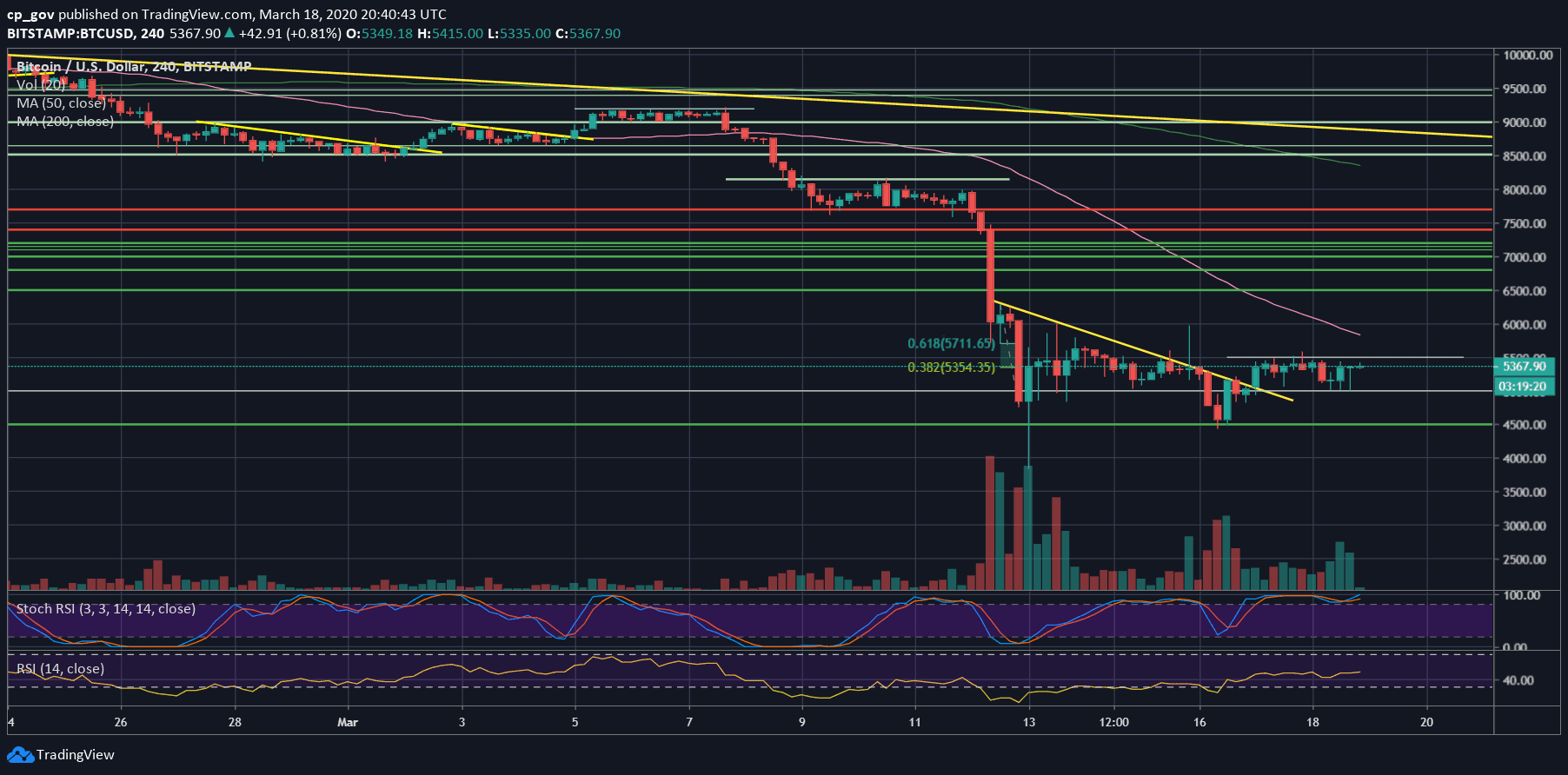
– Support/Resistance levels: As mentioned above, the overall picture can be seen on the 4-hour chart below. Bitcoin is trading between $5000 from below, and $5500 from above. A breakout to either direction is likely to point the next short-term for Bitcoin.

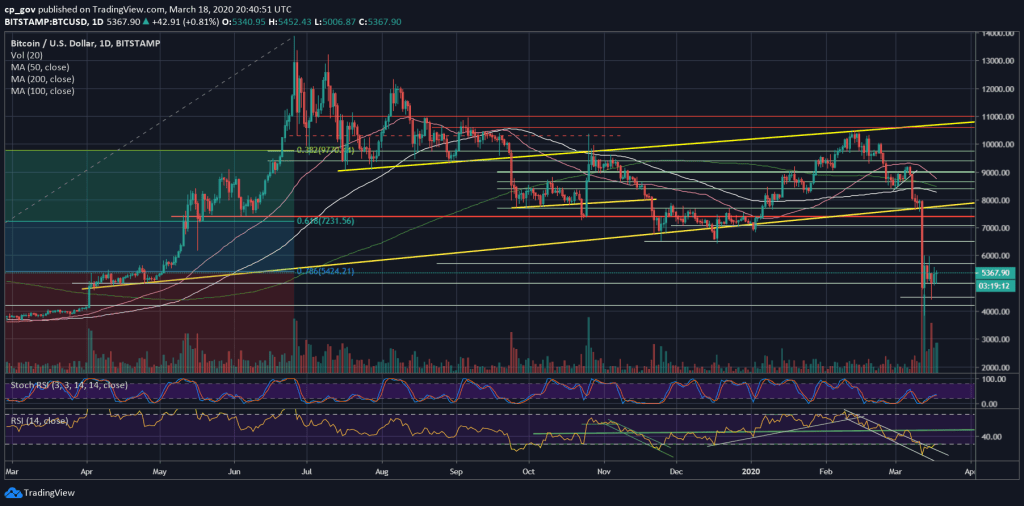
From above, the first resistance is the $5500 price zone (the 78.6% Fib retracement level from the June 2019 bull-run), followed by $5700. Further above lies $6000 – $6100 (Sunday’s high).

From below, the first major level of support is the $5000 mark. Further below lies $4700 – $4800. Beneath, there is the Monday’s low around $4500, before the next significant level at $4200 (old resistance turned support level from the beginning of 2019), and the $4000 mark.

– The RSI Indicator: The RSI is at a decision point. After breaking out of the marked wedge, which started forming a month ago, the RSI is facing the 30 level as resistance. A break here can boost the bulls.

– Trading volume: As mentioned here before, Thursday and Friday, March 12 & 13, were the two highest daily volume candles over the past year. Since then, the volume had been declining, getting ready for the next move.

BTC/USD BitStamp 4-Hour Chart

BTC/USD BitStamp 1-Day Chart

Categories
Uncategorized

Bitcoin Faces Another Down Day as Equities Reject Stimulus Efforts

Bitcoin (BTC) is again feeling the pull of gravity as investors offload risk in traditional markets despite the massive U.S. stimulus package this week.

The top cryptocurrency by market value is currently trading near $5,050, having failed to establish a strong foothold above $5,500 late Tuesday., according to CoinDesk’s Bitcoin Price Index.

Prices were better bid 24 hours ago when global equities were flashing green. Sentiment, however, soured during Wednesday’s Asian trading hours and futures tied to the S&P 500 fell by 5 percent, triggering a “limit down” – the maximum percentage decline possible in one trading day.

Asian equities also put in a weak performance, providing negative cues to the major European equity indices, which are currently down at least 3 percent.

“Global equities markets continue to reject stimulus efforts put forward by the U.S., with the S&P 500 recording its largest one day drop on Monday since 1987,” said Matthew Dibb, co-founder and COO of Stack, a provider of cryptocurrency trackers and index funds.The U.S. Federal Reserve delivered an emergency rate cut of 100 basis points early Monday and announced new quantitative easing in the form of at least $700 billion in asset purchases. Further, the Trump administration said Tuesday it’s planning to send checks directly to U.S. citizens as part of a $1 trillion stimulus program.

Even so, the stock markets are flashing red, which likely indicates investors are worried that monetary easing will not spur economic activity. After all, the threat to global supply and demand is not being caused by institutional systemic failures but by measures related to the growing coronavirus pandemic.

As a result, a sustainable price recovery in both stocks and bitcoin may remain elusive until there is a stabilization in the coronavirus infection curve.

“However, if the impact of the coronavirus outbreak intensifies beyond the global lockdown we are already experiencing, it could spark a further run for cash,” Simon Peters, analyst and crypto-asset expert at multiasset investment platform eToro, told CoinDesk.

Should that happen, investors may again look to bitcoin as a source of liquidity, leading to another wave of selling.

Bitcoin is currently consolidating, showing indecision in the marketplace, said Peters. That seems to be the case as the cryptocurrency is stuck in a triangle pattern on an intraday chart.Bitcoin has carved out an ascending triangle that comprises two trendlines – a horizontal line connecting price resistance and a rising trendline joining higher lows.

A four-hour close above the upper edge of the triangle, currently at $5,945, would open confirm an ascending breakout and open the doors for $6,425 (December low).

However, if the lower end of the triangle at $4,865 is breached, more sellers may join the market, yielding a re-test of recent lows under $4,000.The 14-day relative strength index is signaling oversold conditions with a below-30 reading, while the MACD histogram is producing higher lows below the zero line, a sign of weakening bearish momentum.

A triangle breakout on the 4-hour chart, if confirmed, could be followed by a quick rally to $6,000.

Categories
Uncategorized

Bitcoin, Not Governments Will Save the World After Crisis

Amid some notable recovery of Bitcoin (BTC) after a number of subsequent market crashes last week, billionaire investor Tim Draper delivered another optimistic forecast about Bitcoin.

In a March 16 interview with 415 Stories podcast, Draper outlined decentralization powered by Bitcoin and other new technologies as a major tool that has the “ability to transform the biggest industries in the world.”

“It will be Bitcoin, not banks and governments that save the day”
According to Draper, Bitcoin will be one of the most crucial tools in the times of the recovery of the ongoing global financial crisis, opposing the major cryptocurrency to centralized structures like banks and governments. Referring to the interview, Draper tweeted:

“Entertainment for while you are holed up. When the world comes back, it will be Bitcoin, not banks and governments that save the day.”

In the interview, Draper expressed confidence that new technologies like Bitcoin and artificial intelligence (AI) have the potential to completely transform all the industries from banking to healthcare and real estate, tapping trillions of dollars of their value. As an example, Draper cited a use case in the insurance industry, arguing that the combination of AI, blockchain-powered smart contracts and Bitcoin is a perfect start for an insurance company.

Draper said:

“For example, I could start an insurance company with an actuary AI to determine fraud and a smart contract with Bitcoin and put it all on the blockchain.”

Categories
Uncategorized

Bitcoin Cash Meetups Go Virtual in Japan to Prevent Coronavirus Spread

Japan’s crypto community has found a way for those seeking to avoid crowded places to still participate in meetups across the country.

According to sources, Bitcoin Cash (BCH) meetup groups in Osaka and Tokyo will be allowing members to virtually chime in at regularly scheduled events.

Though Japan has less than 1000 reported cases of infection, companies and organizers in the birthplace of crypto are starting to offer more suggestive language in announcements to curb the spread of the disease. Namely, that people should work from home, reduce time on public transit, and not attend large gatherings.

The Tokyo Bitcoin Cash Meetup group originally had two meetings scheduled for March which had to be cancelled due to the coronavirus pandemic. However, BCH meetup organizer Akane Yokoo notified group members — called “cashers” or “Bitcoiners” — on March 17 that the meetups would instead be held virtually:

“Our virtual meetups will start this coming Wednesday March 18th from 7:30pm and we plan to host every Wednesday at the same time when our physical meetups happen.”

Virtual meetings as well as in-person gatherings
High-demand items like toilet paper, masks, and hand sanitizer are still not quite as available in Japan as they were prior to the coronavirus outbreak, which makes it difficult for those in at-risk groups to attend physical BCH meetups. However, for those who are comfortable and taking necessary precautions, Yokoo suggested that visiting meetings in person was also possible:

“Even though we do not want to encourage members to go out and get sick, members should be free to do whatever they choose to do. If they choose to get together physically, the merchants are open for business as usual.”

Japan events postponed or delayed due to corona
With more crypto companies around the world suggesting or ordering employees to work from home, blockchain and cryptocurrency conferences and meetings have also been taking similar actions to combat the spread of the coronavirus.

Unfortunately, not all events in Japan have been able to move so successfully into the virtual world. The TEAMZ Blockchain Summit — the largest blockchain conference in Japan — was going to take place from April 22–23, but has been rescheduled to September 28.

Public gatherings for Tokyo’s cherry blossom season have been discouraged as well, with the flowers predicted to start blooming next week.

Categories
Uncategorized

Analyst: Cryptocurrency Collapse Is Final Shake Out Before Moon

Last week, the cryptocurrency market valuation was cut in half in less than 48 hours, wiping out over $100 billion value.

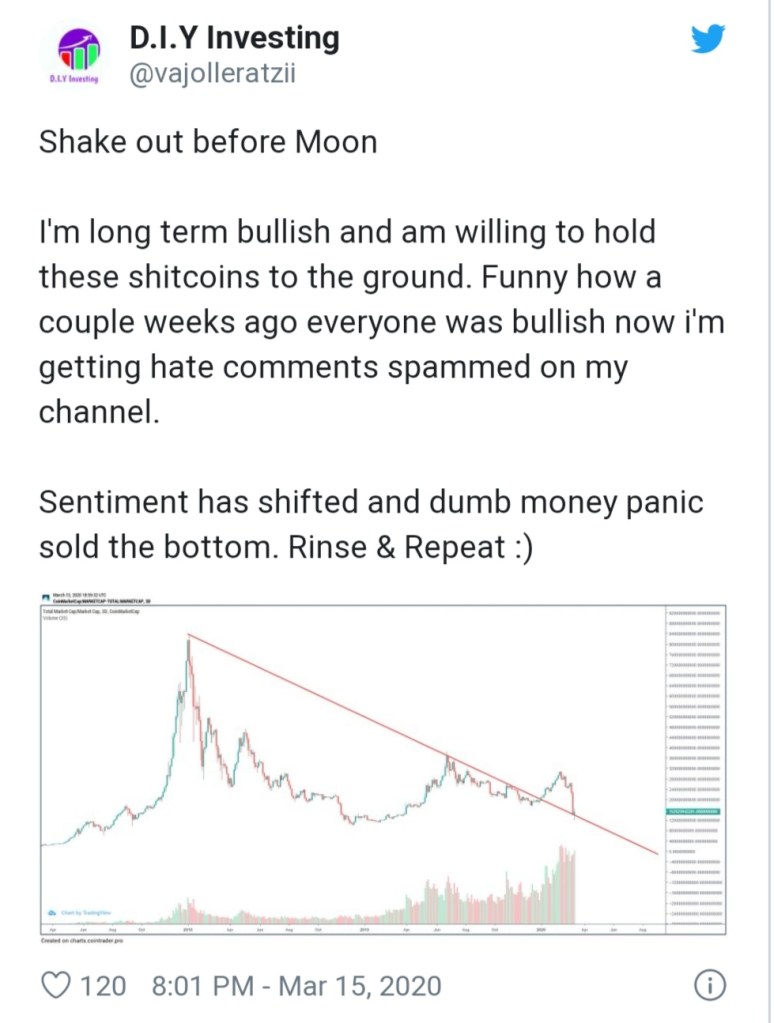
The catastrophic collapse, however, could be the final shakeout before “moon,” according to one crypto analyst who bases the theory on the fall acting as a retest of downtrend line support – support that has held strong.

Cryptocurrency Market Loses Half Its Value in 48 Hours

The cryptocurrency market, along with traditional markets, was a complete and utter bloodbath last week. The Dow Jones set a record for its largest drop since 1987, and the total cryptocurrency market cap was cut in half in under 48 hours. Bitcoin itself fell from $7,200 to under $4,000 during this historic selloff.

Investors are in a panic over the potential implications the coronavirus will have on daily activities, the economy, and possibly their health. But any investors selling now, according to one cryptocurrency analyst, may end up being “dumb money” that sells the absolute bottom of the final shakeout before moon.

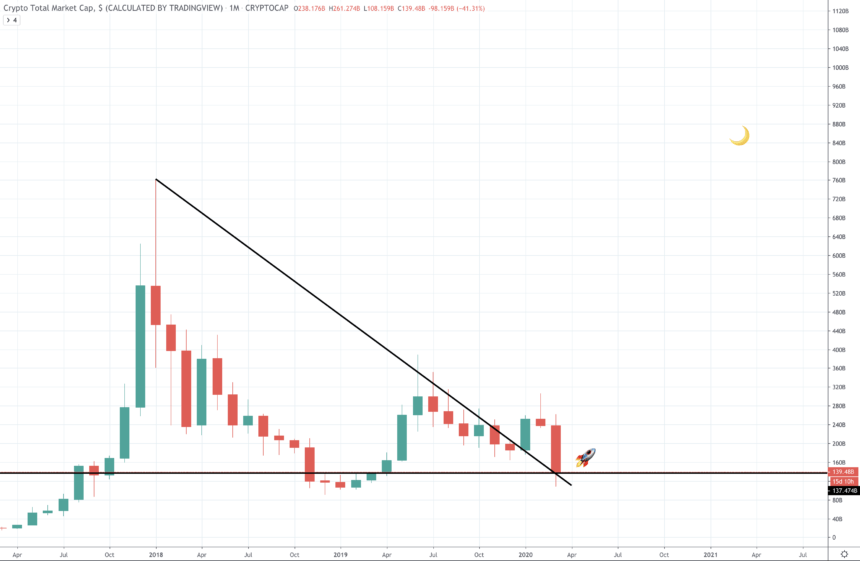
On the total cryptocurrency market price chart on high timeframes, a massive breakout of downtrend resistance occurred in late 2019, causing a powerful rally that led most cryptocurrencies to gain 50% or more in less than two months.

Horizontal resistance and a spillover effect from the stock market and coronavirus concerns proved to be too much and caused massive selloff to a new yearly low.

However, that drop also fell back to the downtrend resistance line, where it is currently holding as support.

Bullish Retest of Downtrend Line, Could Be Launchpad for Moon Mission

If the line holds, this entire move, as bearish as it may seem, could be a bullish retest of the downtrend resistance line and the final shakeout before moon, as the analyst claims.

Breakouts of support and resistance are more often than not retested to confirm a flip from one into the other .

A perfect example of this was during the historic China pump in late October 2019. While it was the third-largest single-day rise in Bitcoin’s history, it only confirmed overhead resistance at $10,500 as such, and the first-ever cryptocurrency set two lower lows after the two times reaching that level.

Neither Bitcoin and the total cryptocurrency market confirmed horizontal resistance as support after the breakout in April 2019. All this time later, that retest may have just happened. As can be seen on monthly timeframes, the total crypto market cap came back down to confirm the bottom accumulation range from back in December 2018, as resistance turned support.

If this line holds, just like the analyst says, it could have been the final shakeout before the cryptocurrency market cap takes off toward the moon once again.

Categories
Uncategorized

Extreme Fear’ Grips Markets Despite Oversold Bitcoin Price Metrics

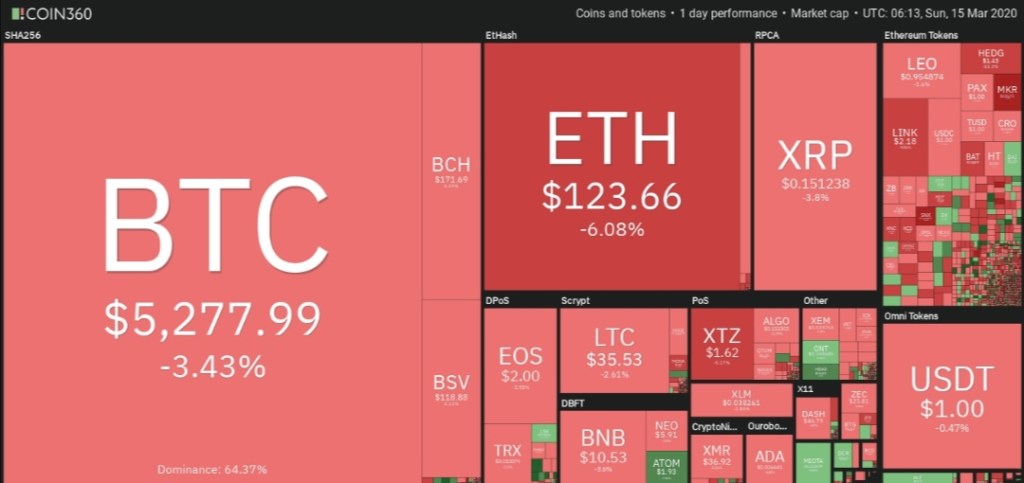
Compared to the trading action of earlier this week, Bitcoin’s (BTC) price was relatively muted on Saturday as the digital asset traded between $5,045 and $5,641. Although the digital asset dropped more than 50.8% on March 12, it has since regained 37.5% to trade at $5,200. 

Crypto market daily price chart. Source: coin360

Many in the crypto space are still attempting to piece together a narrative that explains the carnage of the past week and for the time being, the weekend closure of major equities markets appears to be mitigating some of the Coronavirus fear, which has negatively impacted both markets for weeks.

Some traders and analysts continue to point accusatory fingers at BitMEX, claiming foul play on their part allowed the situation to escalate to near catastrophic levels.

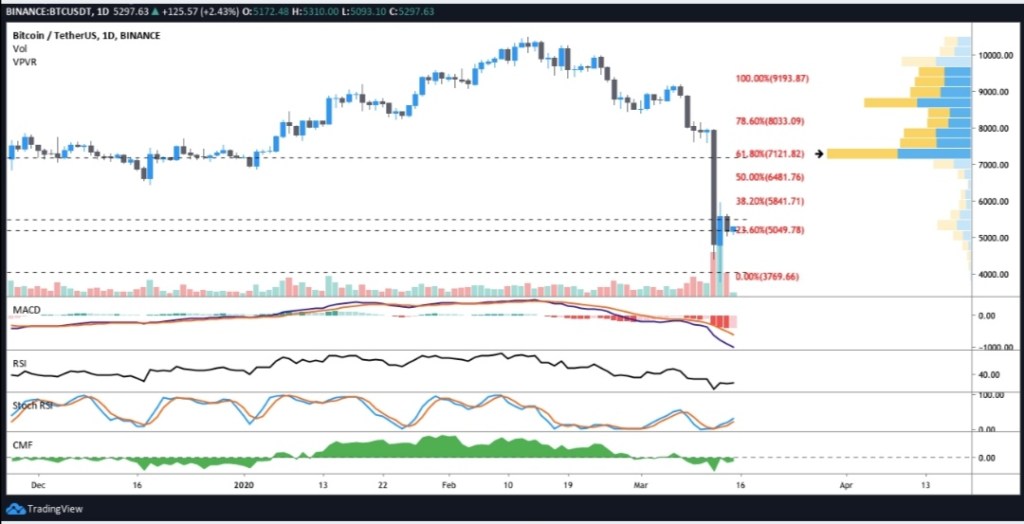
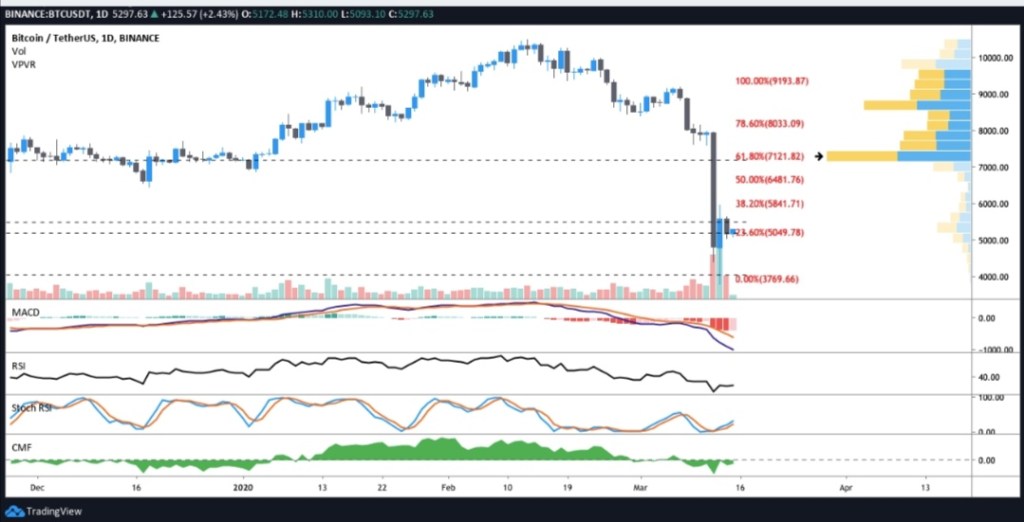
BTC USDT daily chart. Source: Tradingview

At the time of writing, there is a neutral Doji candlestick on the daily timeframe, showing traders remain uncertain on the direction the price may take and the candlestick by itself is neither bullish or bearish. 

Referring to other indicators helps provide a better picture of the prevailing trend and a glance at the relative strength index (RSI) shows the indicator flat in oversold territory 

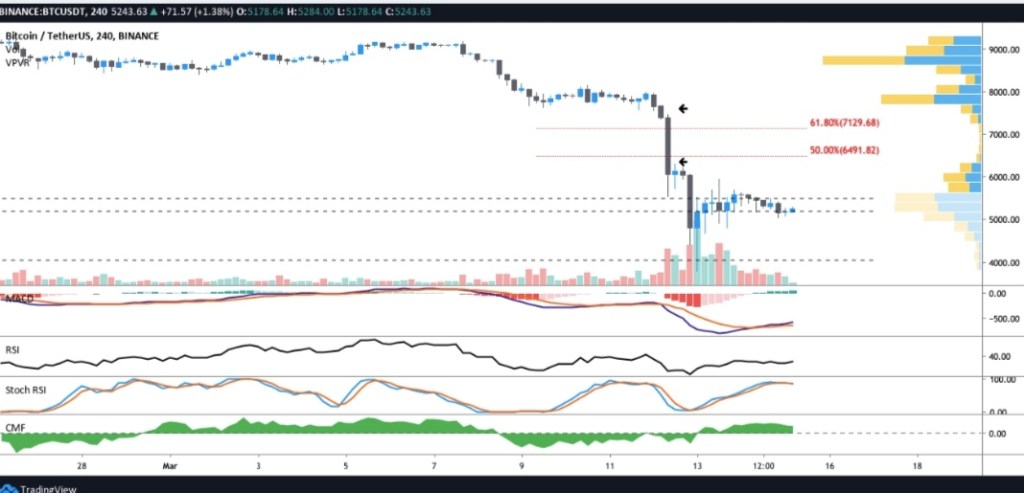
BTC USDT 4-hour chart. Source: Tradingview

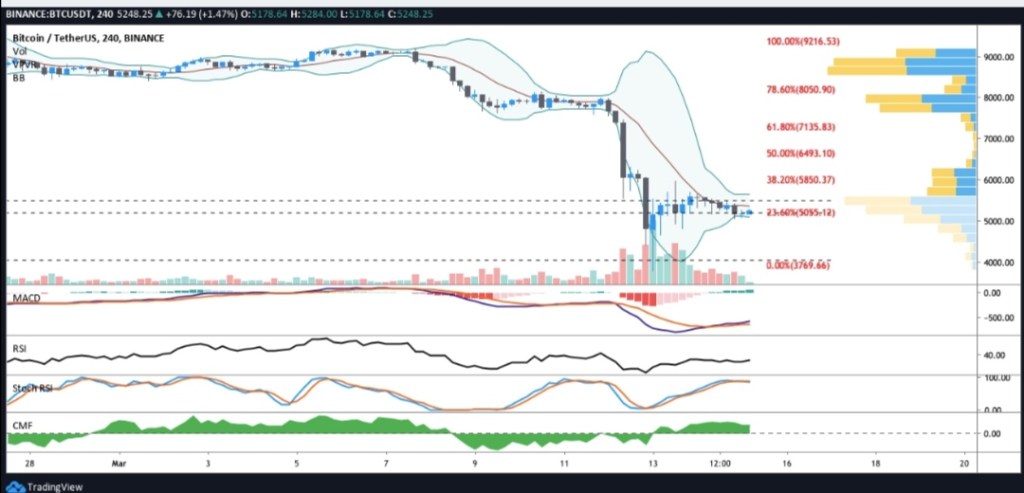
On the shorter, 4-hour timeframe, traders will notice that the RSI remains flat as buy and sell volume decrease and Bitcoin trades within a narrowing range between $5,517 and $5,021.

Some traders would argue that the short-term frame supports a bullish case for Bitcoin as each 4-hour candlestick has formed a lower-high as price descends lower but the moving average convergence divergence, Stochastic RSI and RSI trend upward, and the MACD histogram shows an increase in positive momentum.

Such bullish divergences have been the signal du jour for crypto traders for some time and the drop in trading volume and tightening Bollinger Bands also signal that an explosive move is bound to occur before the weekly close.

Currently, the price is pinned beneath $5,500 where there is a high volume node on the volume profile visible range (VPVR) and there is support at $5,200 and $4,850. If Bitcoin price could push above $5,500 there is open-air overhead and the price could rise to $7,650 but this is dependent on sustained volume and traders’ confidence that the event which catalyzed to drop to $3,770 has ended.

The current price action suggests that traders are taking profits as the range top is reached instead of opening long positions and buying on breakouts.

Bullish scenario

Bullish means that an investor believes that a stock or the overall market will go higher

BTC USDT 4-hour chart. Source: Tradingview

If the price can break above the $5,500 resistance and reclaim the former support at $6,300 to $6,400 this would be an encouraging step. As mentioned earlier, given Bitcoin’s oversold position and the volume gap from $5,500 to $7,650 could easily be exploited by a high volume spike.

Such a move would set the price back in the $7,750 range Bitcoin traded in prior to last week’s meltdown and also set the asset up for a move back to $8,500.

Bearish scenario

Bearish means that an investor believes a stock will go down, or underperform.

BTC USDT daily chart. Source: Tradingview

As shown by the daily time frame, losing the $5,200 support would be far less than ideal, even though the price Bitcoin bounced higher when the price dropped to $3,770 on March 13. To date, there is sufficient interest in Bitcoin at $3,769, a zone Bitcoin price nearly pierced during the precipitous drop. Below this level, the price of Bitcoin would look to form a double bottom at $3,384 and $3,177.

One must remember that while not uncharacteristic of the sector, Bitcoin price is being heavily impacted by the financial crisis created by the COVID-19 pandemic.

As the situation grows worse, investors expected that the markets will worsen and so a self-fulfilling cycle driven by fear and threat or long-term economic slowdown impact asset prices.

Over the coming weeks, one should expect to see a series of multilateral stimulus packages launched by various governments, thus as equities markets possibly rise from financial bailouts, investor sentiment for risk-on assets, commodities and stocks could improve.

Until then, it might be wise to either wait along the sidelines until a bottom is found in traditional markets or for those trading, play clearly defined ranges and rest in cash by the closing market bell or bedtime each day.

Obviously, some Bitcoin investors will advise taking long positions and accumulating as a range develops but with the current global economic uncertainty, perhaps it is better for those with limited capital to rest in cash in order to live to trade another day.

Categories
Uncategorized

Bill Gates Departs Microsoft Board After Pledging $1.4M to African Blockchain

According to press release , software developer, philanthropist, and Microsoft co-founder Bill Gates will depart the company’s board.

Now 64 years old, the business magnate started Microsoft alongside Paul Allen in 1975. The company is surely most known for its Windows computer operating system, which was first released in 1985 and remains as vital as ever today.

Microsoft announced a blockchain token and data management service at the end of that would be a new tool for users of its enterprise Azure service. Gates himself has also recently backed a blockchain-enabled security service for fintech companies operating in Africa and Asia called Crest, writing a check for $1.4 million earlier this month to help financial technology companies in these areas bring financial services to unbanked populations.

Microsoft’s release explains that Gates’ departure from the board is about making more time for his philanthropy and effort toward tackling climate change.

Design a site like this with WordPress.com
Get started